By mid-1968, NASA faced a severe schedule crisis. The Lunar Module (LM), developed by Grumman Aircraft, was plagued by weight issues and structural wiring defects, making it unready for its planned Earth-orbit flight test on Apollo 8. Meanwhile, CIA intelligence reports suggested that the Soviet Union was preparing a crewed circumlunar mission using their Zond spacecraft atop a Proton rocket before the end of the year. In August 1968, George Low, Manager of the Apollo Spacecraft Program, proposed a bold strategy: skip the planned Earth-orbit LM test and send Apollo 8 directly to lunar orbit using only the Command and Service Module (CSM-103) atop the massive Saturn V rocket.
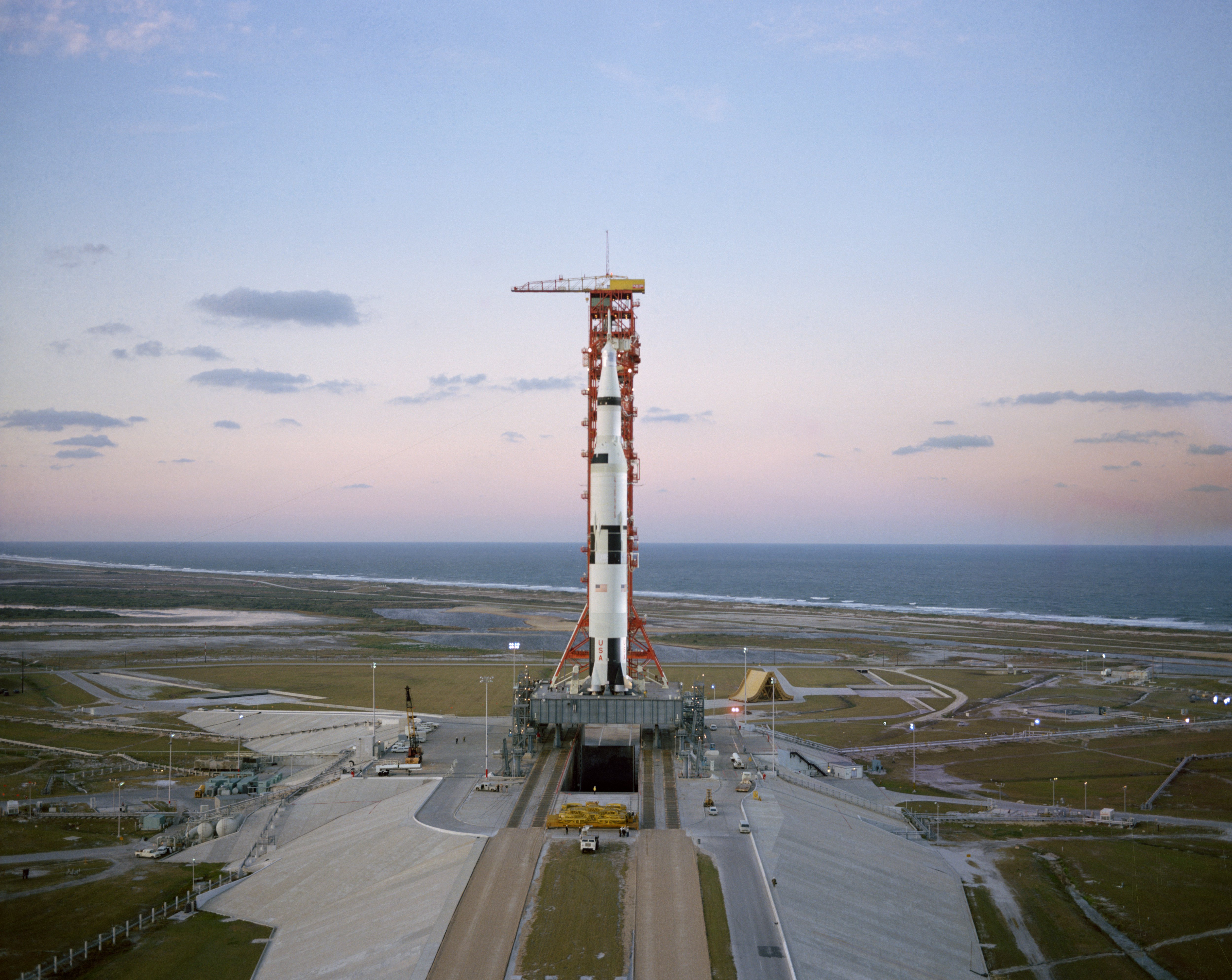
The Saturn V had flown only twice before in uncrewed tests, and its second test (Apollo 6 in April 1968) suffered serious pogo oscillations, severe engine vibrations, and second-stage ignition failures. NASA engineers at the Marshall Space Flight Center under Wernher von Braun worked frantically throughout late 1968 to eliminate pogo by dampening liquid oxygen lines. On December 21, 1968, at 7:51 a.m. EST, Apollo 8 lifted off from Launch Complex 39A at Kennedy Space Center carrying Commander Frank Borman, Command Module Pilot Jim Lovell, and Lunar Module Pilot William Anders. It was the first crewed launch of the 363-foot-tall Saturn V rocket, generating 7.5 million pounds of thrust.
Two hours and fifty minutes after launch, following two orbits in Earth parking orbit to verify systems, Flight Director Michael Griffin's team and Capcom Michael Collins gave the historic order: "Apollo 8, you are Go for TLI" (Translunar Injection). The S-IVB third stage fired for four minutes and eighteen seconds, accelerating the spacecraft from 17,400 mph to 24,200 mph—escape velocity. For the first time in human history, human beings broke free of Earth's gravitational grip and ventured toward another celestial body.
The journey to the Moon took nearly three days across 234,000 miles of cislunar space. Spacecraft systems functioned almost flawlessly, proving that NASA's Saturn V was capable of deep-space operations and marking a decisive turning point in the Cold War Space Race.
Why it matters
Apollo 8's launch represented one of the boldest managerial decisions in aerospace history. By risking three astronauts on the first crewed flight of the Saturn V rocket to attempt humanity's first lunar mission, NASA dramatically reshaped the Space Race. Converting Apollo 8 from an Earth-orbit test to a lunar mission seized the strategic initiative from the Soviet Union, demonstrated translunar navigation, and put the United States within striking distance of fulfilling President John F. Kennedy's goal of landing on the Moon before 1970.
Interesting fact
When the S-IVB stage fired for Translunar Injection, the Apollo 8 crew became the fastest-traveling human beings in history up to that point, reaching 24,225 miles per hour (38,986 km/h) relative to Earth.
People
- Frank BormanCommander
- Jim LovellCommand Module Pilot
- William AndersLunar Module Pilot
- George LowManager, Apollo Spacecraft Program
- Wernher von BraunDirector, Marshall Space Flight Center
Quotes
"Apollo 8, you are Go for TLI."
"You are clear for TLI... You're on your way, you're really on your way now."
Gallery


Location
Launch Complex 39A, Kennedy Space Center · Merritt Island · United States
Open in Google Maps