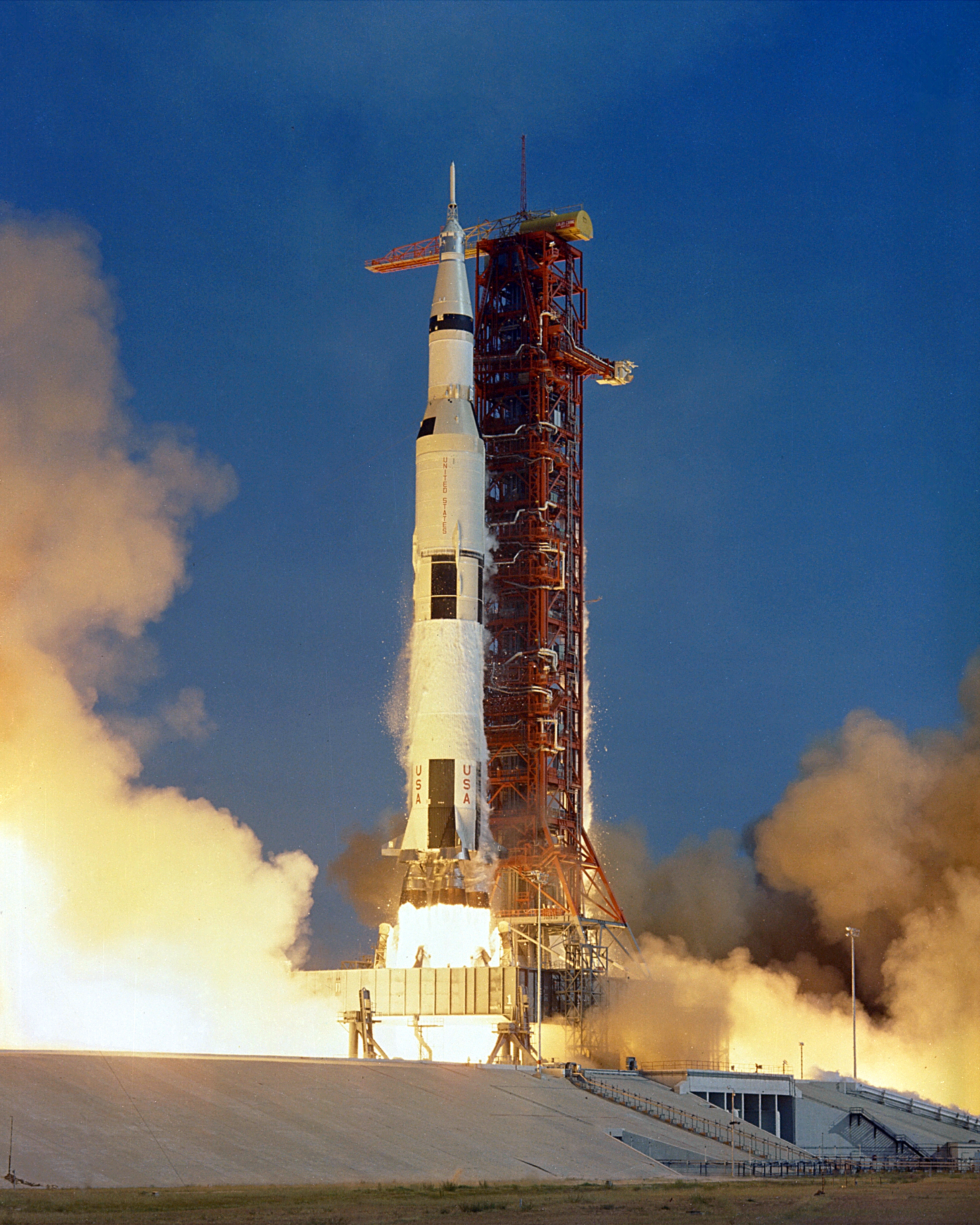
On April 16, 1972, at 12:54 PM EST, Apollo 16 launched from Launch Complex 39A at NASA's Kennedy Space Center aboard a Saturn V rocket. As the second J-series mission, Apollo 16 was targeted toward the central lunar highlands—specifically the Descartes Formation and the Cayley Formation. Pre-mission geological consensus strongly favored the hypothesis that these high-altitude regions were formed by ancient lunar volcanism, which would yield volcanic rocks distinct from the basaltic materials collected in the maria during earlier landings.
The mission was crewed by Commander John Young, Lunar Module Pilot Charles Duke, and Command Module Pilot Thomas 'Ken' Mattingly. During transit and initial orbital insertion around the Moon, the crew and ground controllers executed complex orbital mechanics maneuvers. However, as the Lunar Module *Orion* separated from the Command Module *Casper* to begin landing descent, Mattingly discovered a malfunction in the secondary thrust vector control system of the Command Module's main engine. The potential danger delayed landing by six hours while Mission Control evaluated safety protocols before finally clearing Young and Duke to land on the lunar surface on April 21.
Over the course of three days on the surface, Young and Duke logged over 20 hours of EVAs and drove 27 kilometers in their Lunar Roving Vehicle. The scientific outcome of Apollo 16 surprised planetary scientists: the samples returned, totaling 95.8 kilograms, were almost entirely shock-metamorphosed breccias formed by giant meteoroid impacts rather than volcanic eruptions. This unexpected finding forced geologists to fundamentally revise their theoretical models regarding the origin and evolution of the lunar highlands and impact cratering dynamics across the solar system.
Why it matters
Apollo 16 was the only mission to target the Moon's rugged central highlands, directly testing prevailing scientific theories regarding lunar geological evolution. By demonstrating that the Descartes region was created by ancient impact debris rather than volcanic action, Apollo 16 corrected major scientific misconceptions, altered how geologists interpreted cratering processes across terrestrial planets, and retrieved nearly 100 kilograms of invaluable highland samples.
Interesting fact
During Apollo 16, astronaut Charles Duke placed a small, framed family photograph of himself, his wife, and their two sons on the lunar surface, where it remains sitting in the lunar dust today.
People
- John YoungApollo 16 Commander
- Charles DukeApollo 16 Lunar Module Pilot
- Thomas 'Ken' MattinglyApollo 16 Command Module Pilot
Quotes
"There you are, mysterious and unknown Descartes. Apollo 16 is gonna turn your secrets over to the world."
Gallery

.png)


Location
Kennedy Space Center, Launch Complex 39A · Cape Canaveral · United States
Open in Google Maps