As the Apollo lunar exploration program wound toward its end in the early 1970s, NASA sought to repurpose excess Apollo flight hardware through the Apollo Applications Program. The central project became Skylab, America's first orbital space station. Rather than building a space station from scratch, NASA engineers engineered an ingenious modification: converting a Saturn IB second stage (S-IVB) into a fully outfitted two-story orbital workshop, equipped with living quarters, solar observatories, and scientific laboratories, providing an unprecedented 361 cubic meters of pressurized interior volume.
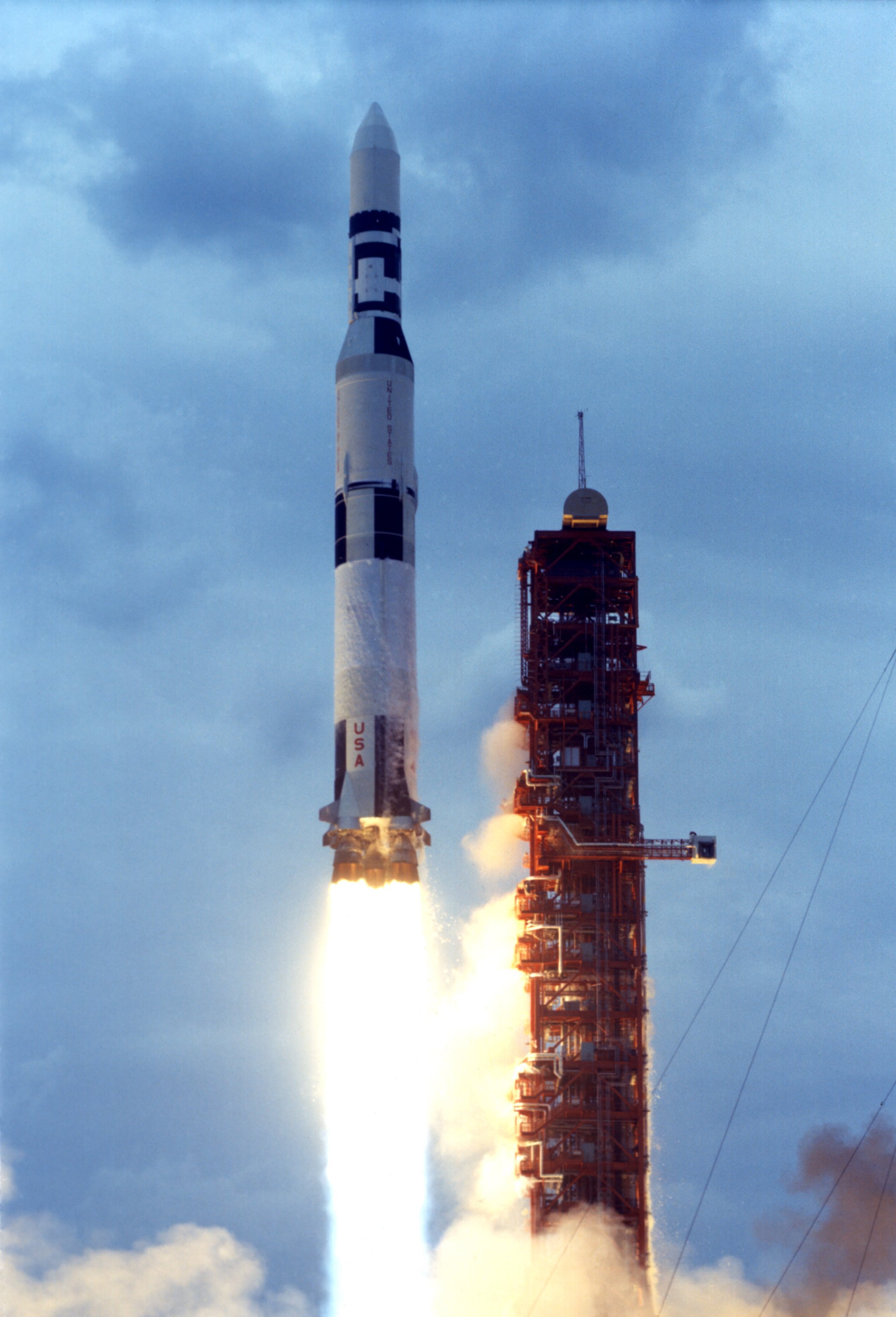
On May 14, 1973, the uncrewed Skylab 1 orbital workshop launched from Kennedy Space Center atop the giant Saturn V rocket—marking the final launch of the historic Saturn V vehicle. However, just sixty-three seconds into ascent, severe aerodynamic forces caused the station's micrometeoroid shield to deploy prematurely. The supersonic slipstream ripped away the shield along with one of Skylab's two primary solar arrays, while debris jammed the remaining solar array wing, preventing it from extending in orbit.
Upon reaching orbit, Skylab was functionally crippled. Lacking its protective thermal shield, internal temperatures surged to over 50 degrees Celsius (120 degrees Fahrenheit), threatening to ruin onboard food, medical supplies, film, and delicate scientific experiments. Over ten dramatic days, flight directors, engineers at the Marshall Space Flight Center, and astronaut crews worked around the clock on Earth to engineer bespoke repair equipment, including a collapsible parasol thermal shade and custom wire cutters.
On May 25, 1973, the Skylab 2 crew commanded by Pete Conrad launched to rescue the station. Through dangerous extravehicular activities, the crew deployed the parasol shade and unjammed the solar array, restoring power and life support. Skylab subsequently hosted three successful crewed missions between May 1973 and February 1974, proving that humans could survive and perform complex scientific work during extended spaceflights, laying essential groundwork for future orbital outposts like the International Space Station.
Why it matters
Skylab 1 demonstrated the immense practical value of human spaceflight beyond the Space Race context, shifting NASA's focus toward long-duration scientific research in microgravity. By utilizing leftover Saturn hardware, NASA proved the viability of large orbital habitats. Furthermore, the dramatic in-orbit emergency repairs executed by the Skylab 2 crew demonstrated human adaptability and problem-solving in space, providing operational lessons that directly shaped future space station design, astronaut training, and extravehicular operations.
Interesting fact
Skylab's main living section was so large that astronauts could run around its interior circumference in zero gravity, performing full mid-air loops and creating orbital gymnastics tricks impossible inside smaller spacecraft.
People
- Charles "Pete" ConradCommander, Skylab 2 Rescue Mission
- Joseph P. KerwinScience Pilot, Skylab 2
- Paul J. WeitzPilot, Skylab 2
- Rocco PetroneDirector, NASA Marshall Space Flight Center
Quotes
"We have liftoff of Skylab, America's first space station!"
Gallery
.jpg)
.jpg)

.jpg)
Location
Kennedy Space Center Launch Complex 39A · Titusville · United States
Open in Google Maps