
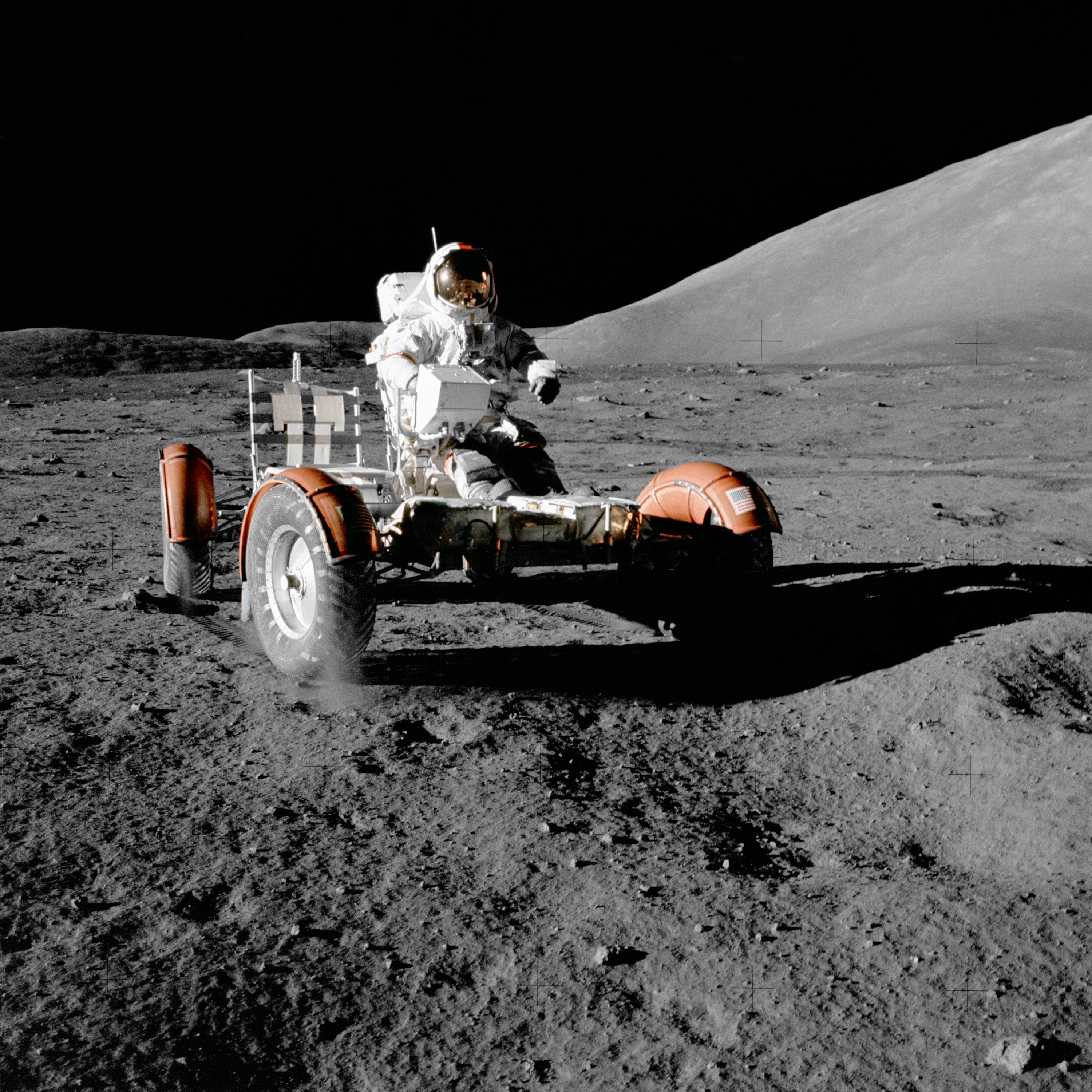
The Apollo 17 mission in December 1972 represented the grand scientific finale of NASA's lunar landing program. Conceived as a "J-series" mission featuring extended stay times and advanced scientific mobility, Apollo 17 targeted the Taurus-Littrow valley—a complex geological site bordered by rugged highlands and believed to contain both ancient crustal material and young volcanic vents. Commanding the mission was Eugene Cernan, accompanied by Lunar Module Pilot Harrison "Jack" Schmitt, the first trained professional geologist to travel to space, while Command Module Pilot Ronald Evans remained in lunar orbit aboard America.
On December 14, 1972, during the mission's third and final extravehicular activity (EVA), Cernan and Schmitt concluded over 22 hours of surface exploration. Over three days on the Moon, they traversed more than 35 kilometers using the Lunar Roving Vehicle and gathered 110.5 kilograms of rock and soil samples, including the celebrated orange volcanic glass at Shorty Crater. As the EVA drew to a close near their Lunar Module Challenger, Schmitt re-entered the spacecraft first, leaving Cernan alone on the dust-covered surface.
Standing near the ladder of the ascent stage, Cernan paused to deliver a final reflection on humanity's giant leap. He noted that America's challenge of the era had forged human destiny for tomorrow, expressing faith that humanity would return to the Moon in peace and hope. Stepping onto the ladder at 05:40 UTC, Cernan left behind the final human footsteps on the lunar surface of the twentieth century.
The immediate aftermath was a triumphant return. Challenger lifted off the Moon to rendezvous with Evans in orbit, followed by a successful splashdown in the South Pacific Ocean on December 19, 1972. However, the broader legacy of the moment was bittersweet. With Apollo 18, 19, and 20 canceled due to shifting national priorities and severe budget reductions, Cernan's footsteps marked the sudden closing of deep-space human exploration. For over five decades, Apollo 17 remained the outer boundary of human physical presence in the cosmos, standing as a high-water mark of twentieth-century technological achievement.
Why it matters
Gene Cernan's final footsteps on the Moon marked the conclusion of the Apollo program, closing an extraordinary chapter in human history. In just three and a half years, twelve American astronauts walked on the lunar surface, collecting invaluable geological data and proving humanity's capability to reach another celestial body. Cernan's departure initiated a multi-decade pause in crewed deep-space exploration, transforming Apollo into both a monumental historical legacy and an enduring benchmark for future spacefaring endeavors.
Interesting fact
Before entering the Lunar Module for the last time, Gene Cernan traced his daughter Tracy's initials ('TDC') into the fine lunar dust, where they remain preserved today undisturbed by atmospheric erosion.
People
- Eugene CernanCommander, Apollo 17
- Harrison "Jack" SchmittLunar Module Pilot and Geologist, Apollo 17
- Ronald EvansCommand Module Pilot, Apollo 17
- Robert F. OvermyerCAPCOM, Mission Control
Quotes
"As I take man's last step from the surface, back home for some time to come – but we believe not too far into the future – I'd like to just (say) what I believe history will record: that America's challenge of today has forged man's destiny of tomorrow."
Gallery


Location
Taurus-Littrow Valley
Open in Google Maps