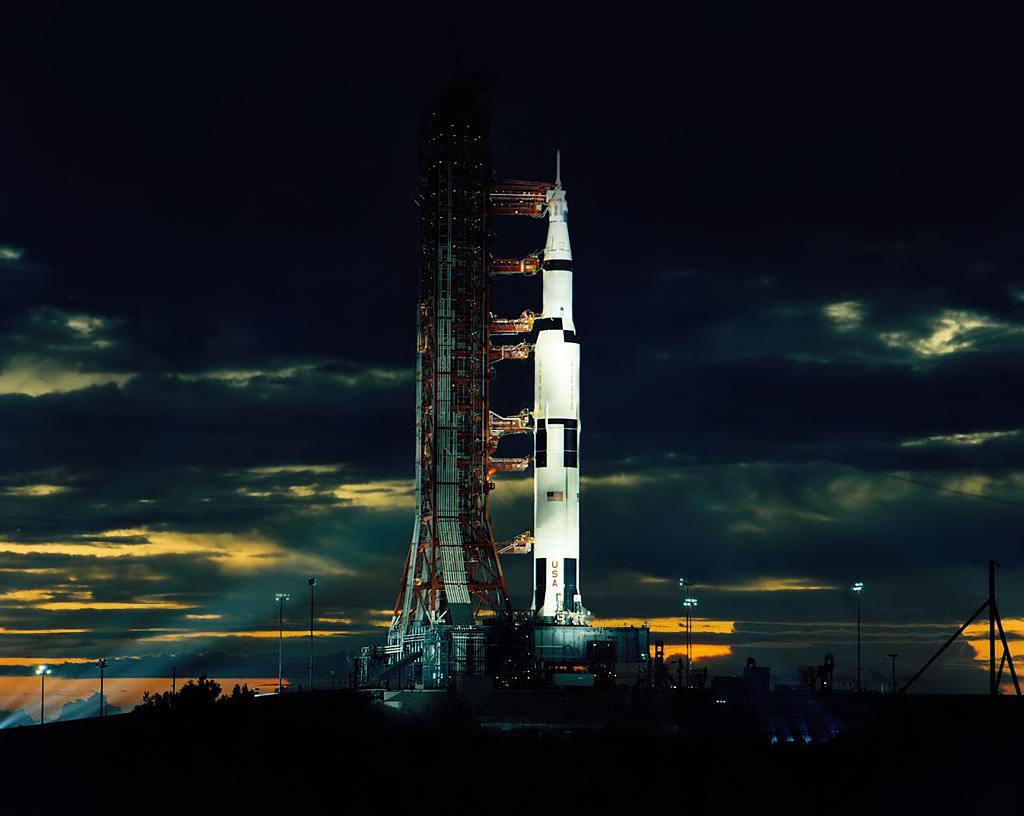
At 12:33 AM EST on December 7, 1972, Apollo 17 lifted off from Launch Complex 39A at NASA's Kennedy Space Center, marking the only night launch of the Saturn V rocket. The towering rocket illuminated the Florida coastline for hundreds of miles, providing a dramatic spectacle for an estimated 500,000 spectators. As the final lunar landing mission of Project Apollo, Apollo 17 represented the culmination of America's lunar exploration program, combining advanced hardware, extended surface duration, and refined scientific objectives.
The crew comprised Commander Eugene Cernan, Command Module Pilot Ronald Evans, and Lunar Module Pilot Harrison 'Jack' Schmitt. Apollo 17 was notable for including Schmitt, a Harvard-trained geologist, who became the first professional civilian scientist to fly to the Moon. NASA selected the Taurus-Littrow valley as the landing site—a deep, geologically complex region surrounded by steep mountains that offered access to both ancient highland material and young, potentially volcanic rocks. On December 11, the Lunar Module *Challenger* touched down safely in the valley.
During their 75-hour stay on the lunar surface, Cernan and Schmitt completed three EVAs totaling over 22 hours outside the lander. Using their Lunar Roving Vehicle, they covered 35.7 kilometers and collected 110.5 kilograms of lunar samples, including unique orange volcanic glass beads discovered by Schmitt at Shorty Crater. When Cernan re-entered the Lunar Module on December 14, 1972, he became the last human to stand on the lunar surface in the 20th century, ending an extraordinary era of space exploration.
Why it matters
Apollo 17 brought the historic Apollo lunar landing program to a grand scientific climax, setting permanent records for the longest extravehicular activity time, the longest lunar surface stay, and the largest total sample mass returned. The inclusion of Harrison Schmitt, a professional geologist, maximized the scientific return of the landing, providing deep insights into lunar volcanism and early planetary geological processes that continue to inform planetary science today.
Interesting fact
Apollo 17 was the only crewed launch of the Saturn V rocket conducted at night; the brilliance of the five F-1 rocket engines turned the night sky into artificial daylight for miles around Cape Canaveral.
People
- Eugene CernanApollo 17 Commander
- Harrison SchmittApollo 17 Lunar Module Pilot / Geologist
- Ronald EvansApollo 17 Command Module Pilot
Quotes
"As I take man's last step from the surface, back home for some time to come – but we believe not too long into the future – I'd like to just state what I believe history will record. That America's challenge of today has forged man's destiny of tomorrow."
Gallery

_-_KSC_(S72-54814).jpg)


Location
Kennedy Space Center, Launch Complex 39A · Cape Canaveral · United States
Open in Google Maps